


Editorial Note: This week’s newsletter is a two-parter. This post follows last week’s theory component, and gets into how to operationalise the insights from part one.
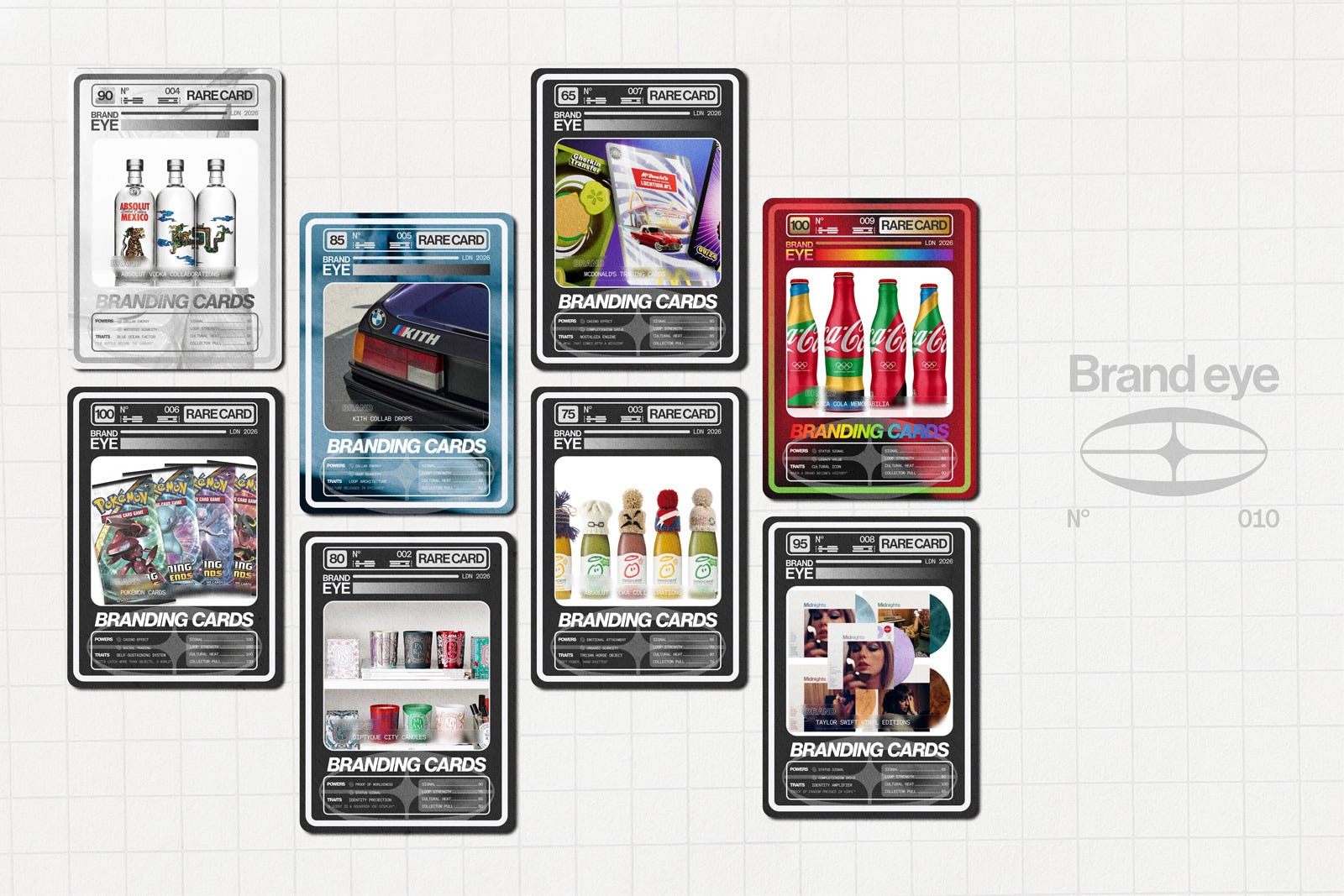
The most expensive billboard in the world can’t prove that people care about your brand. It can prove you have money, but that’s not the same thing. A product someone buys, keeps, and tells other people about? That’s proof. It’s earned, not bought. And the only way to get it is to build a brand world worth collecting.
There’s a craft behind elite collectible branding. It’s not a science, because it will always be a creative endeavour, but it’s not just vibes either. There’s a logic behind it, a series of steps which serve both as wireframe to hold your campaign together, and springboard for your creativity to launch off of.
Here’s how.
Start with Story
As with any campaign, a collectible needs to link back to your brand story. Not a product feature, not a brand value. An idea, a philosophy, a principle which people would want a physical artefact of.
The test is simple: if you stripped the logo off, would the collectible still say something about your brand? If yes, you’re working with Story. If no, you’ve made merch.
Merch ends up in the bin. Artefacts end up on the shelf.
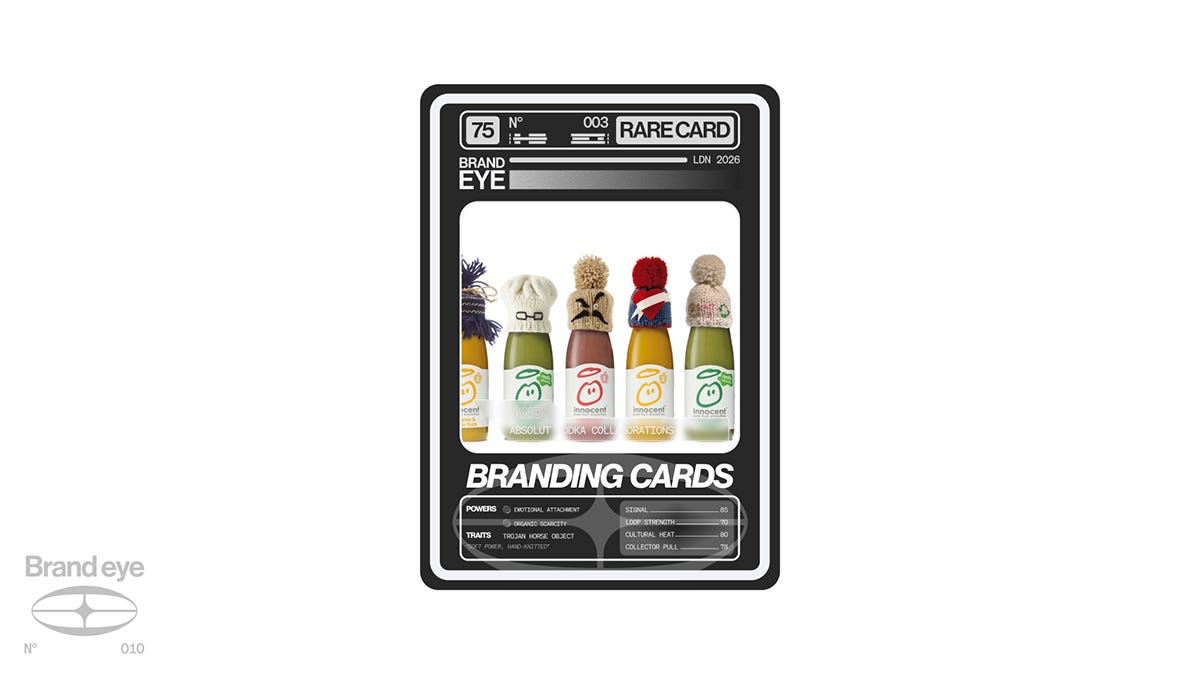
When you’re developing concepts, the question to ask is: what is the central idea of our brand, and what would it look like as an object? Innocent Smoothies’ hand-knitted bottle hats work because they’re a physical expression of the brand’s personality. Warmth, handmade simplicity, a little bit quirky. Remove the Innocent branding entirely and the object still tells you something. That’s the difference.
If you can’t answer what the central idea is, that’s the problem to solve first. A collectible can’t carry an idea that hasn’t been clearly articulated yet. Go back to the brand story and make it more distinct before anything else.
Build the System
Story gives the collectible meaning. As such it’s the prerequisite, but it doesn’t make something collectable. Plenty of beautifully made objects with thought behind their design get bought once and forgotten. What separates a collectible from a well-designed piece of merch is the System — the mechanics that make people come back, complete sets, show off, trade, and engage with the object beyond the moment of purchase.
It has three components.
Defining the Set
Completionism only works when people can see what finishing looks like. The urge to complete something only kicks in when they know there’s something to complete. Market as a set, sell as a unit. If there are eight variants, show all eight. If there’s a rare tier, communicate the rarity. If it’s geographically distributed, make the map visible.
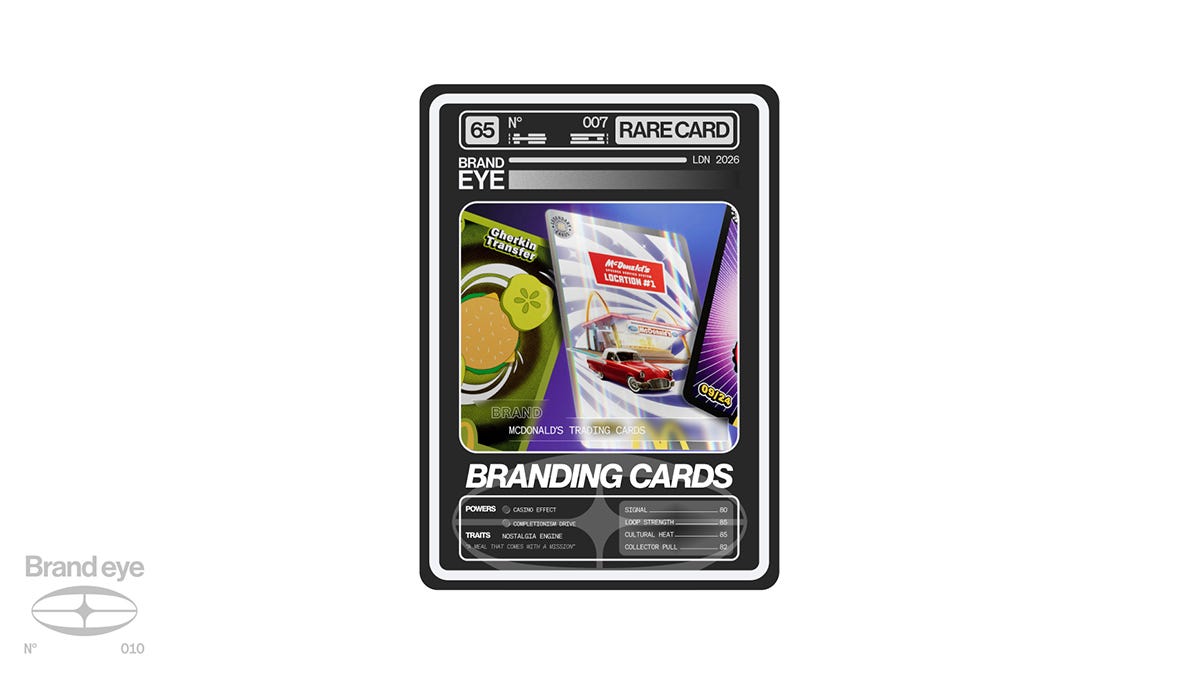
The edges of the set are part of the product. McDonald’s CARDS campaign worked because customers could see the full 24-card set from day one. They knew exactly how incomplete their collection was. That tension is the engine.
Building In the Game
Gamification works in two directions. The first is the moment of acquisition: is there an element of chance or discovery in how people get the collectible? The blind box, the unboxing mechanic, the treasure hunt. The second is what happens after: can people trade, flex, complete, or compete with the object itself?
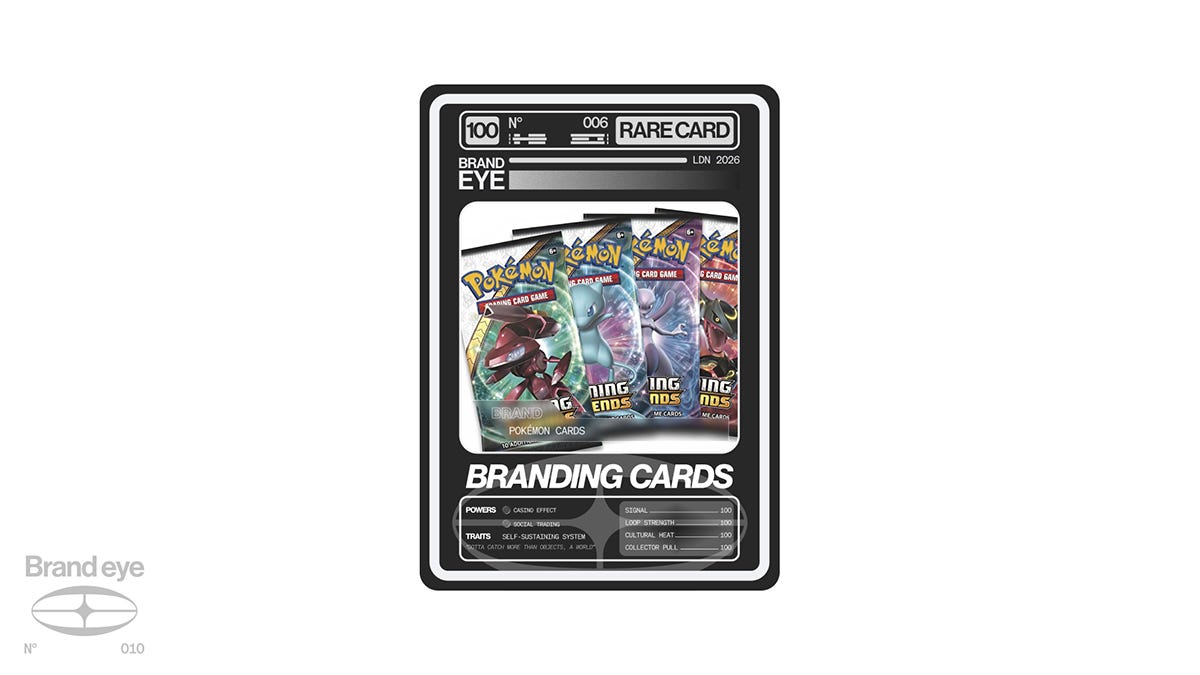
The best systems do both. The acquisition is exciting and the post-acquisition life of the object has its own dynamics built in. Pokémon cards don’t just have the dopamine hit of the booster pack. They have an entire game, a trading economy, and thirty years of community built around what happens after you open it.
Making it Social
A collectible that doesn’t travel doesn’t work. The object needs to function as social currency, something people want to show off, photograph, trade, and talk to others about. Making it something that’s cool or beautiful or interesting is also about making it social.
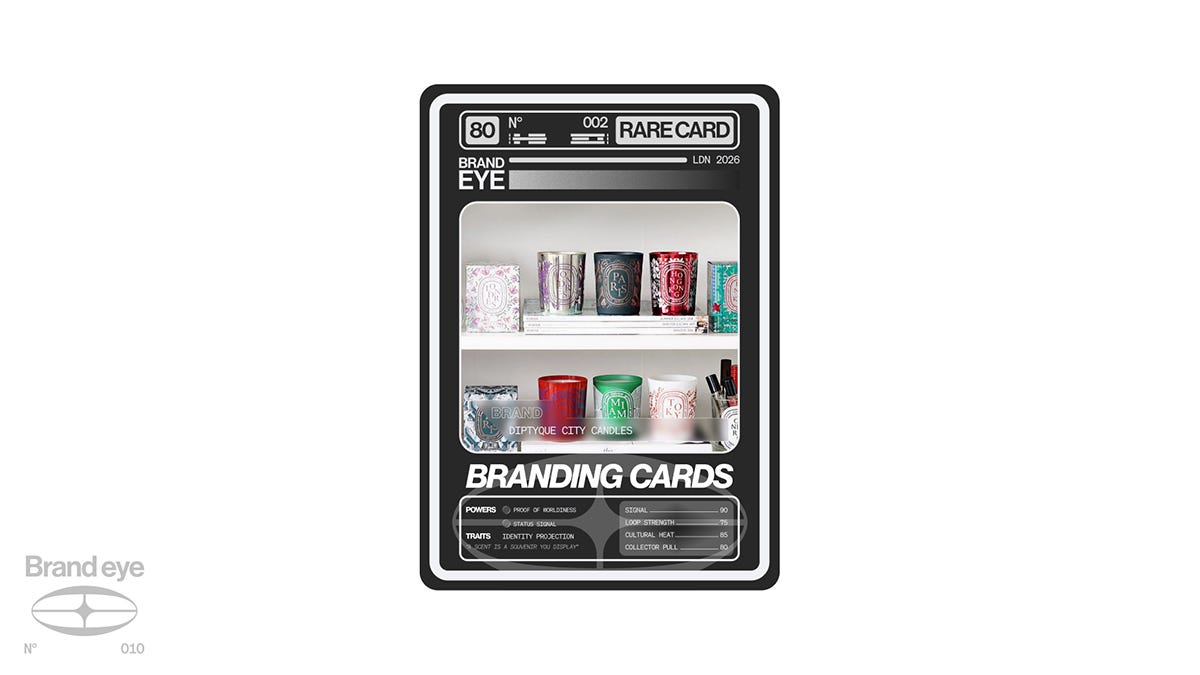
Would people be as obsessed with Diptyque’s geographically limited edition candles if they didn’t also look amazing on a coffee table? Let’s say the maintained all the other characteristics, you still knew they were geographically limited, they still made you feel wordly, they still reminded you of that trip you took to Miami with their Palm Beach inspired scent. But they didn’t have that same element of clout, by showing off their origin. Would they have the same value? Likely not.
Example - Collaborations as Collectibles
Collabs function exceptionally well for certain brands as collectibles, because they’re typically time-limited, and stand out as conspicuous from the ‘ordinary’ offerings of a brand. They also fulfill the social aspect of collectibles, by cross-pollinating fanbases and audiences, and showing cultural literacy and being ‘in the know’.
But they only work when both brand worlds are clearly defined.
Adidas x Raf Simons (Ozweego/Stan Smith) — The Adidas/Raf collab took a mass-market sneaker and placed it inside the world of high fashion. Making it a seasonal drop meant that each colourway becomes a souvenier of sorts. It signals a moment, like vintage tour merch or Jordans.
Crocs collaborations (Balenciaga, MSCHF, Christopher Kane) — When done well, a brand can reinvent its entire brand world through collaboration. That’s what Crocs did in the late 2010’s, with little scope to compete on product design given the plastic mold design, the shoe was a commodity. Easy to rip off. Branding was really the only thing it had going for it, and the brand was generic, until they started doing partnerships.
Then they started collaborating, with Balenciaga, MSCHF, Post Malone, Christopher Kane. Each collab recontextualised what Crocs was. Not an ugly shoe. An ironic cultural artefact. The collaboration was the blue ocean move that made the brand distinct.
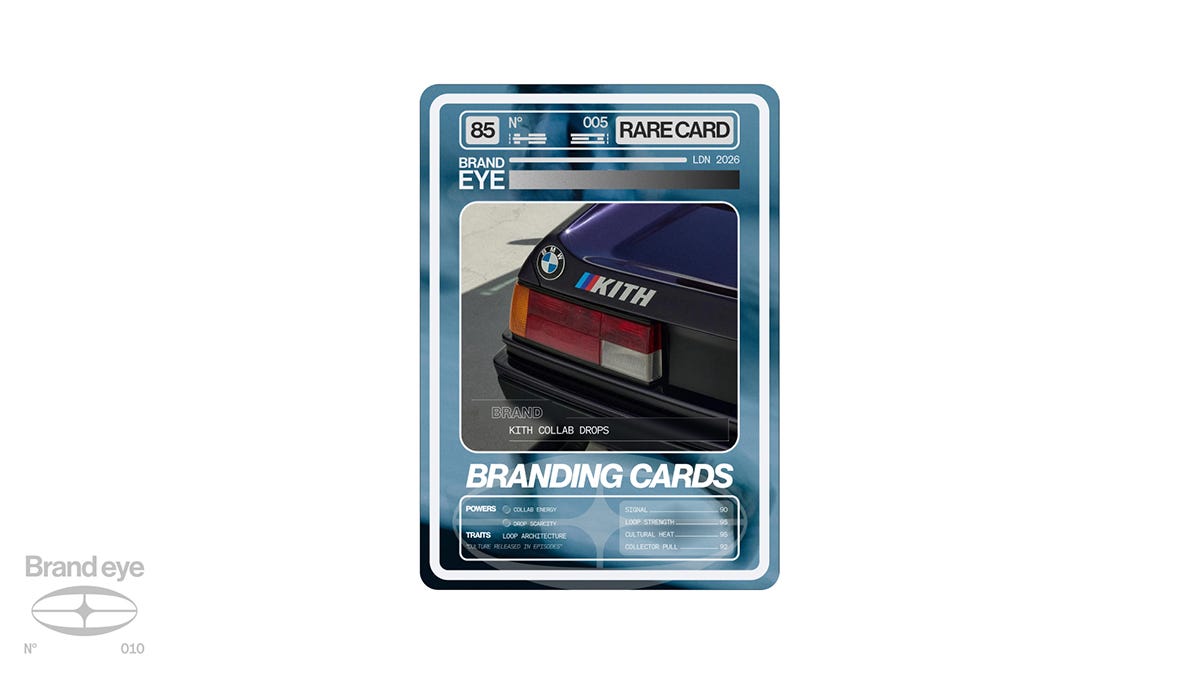
KITH took this further. Ronnie Fieg made collaboration the entire operating model. Each drop is a content moment. Each release reinforces the brand world by making taste and curation wearable. For KITH, the cadence is the System.
The failure mode is when only one brand world is strong. If your story is weak, a collab doesn’t fix it. Crocs didn’y just partner with cool brands, they juxtaposed them with their own lack of cultural cachet. The collision only creates something new when both parties bring something distinct to the table.
Test It Against the Brand World
The Story gives it meaning, the Signal makes it recognisable and the System makes it repeatable. So before you ship anything, two questions.
Does the Story give it meaning beyond the logo? Does the System give people a reason to come back for more?
Then the final one: could a competitor produce this same collectible credibly?
If yes, it’s a product, if no, it’s a collectible. And that’s the difference between something people buy and something people keep.