


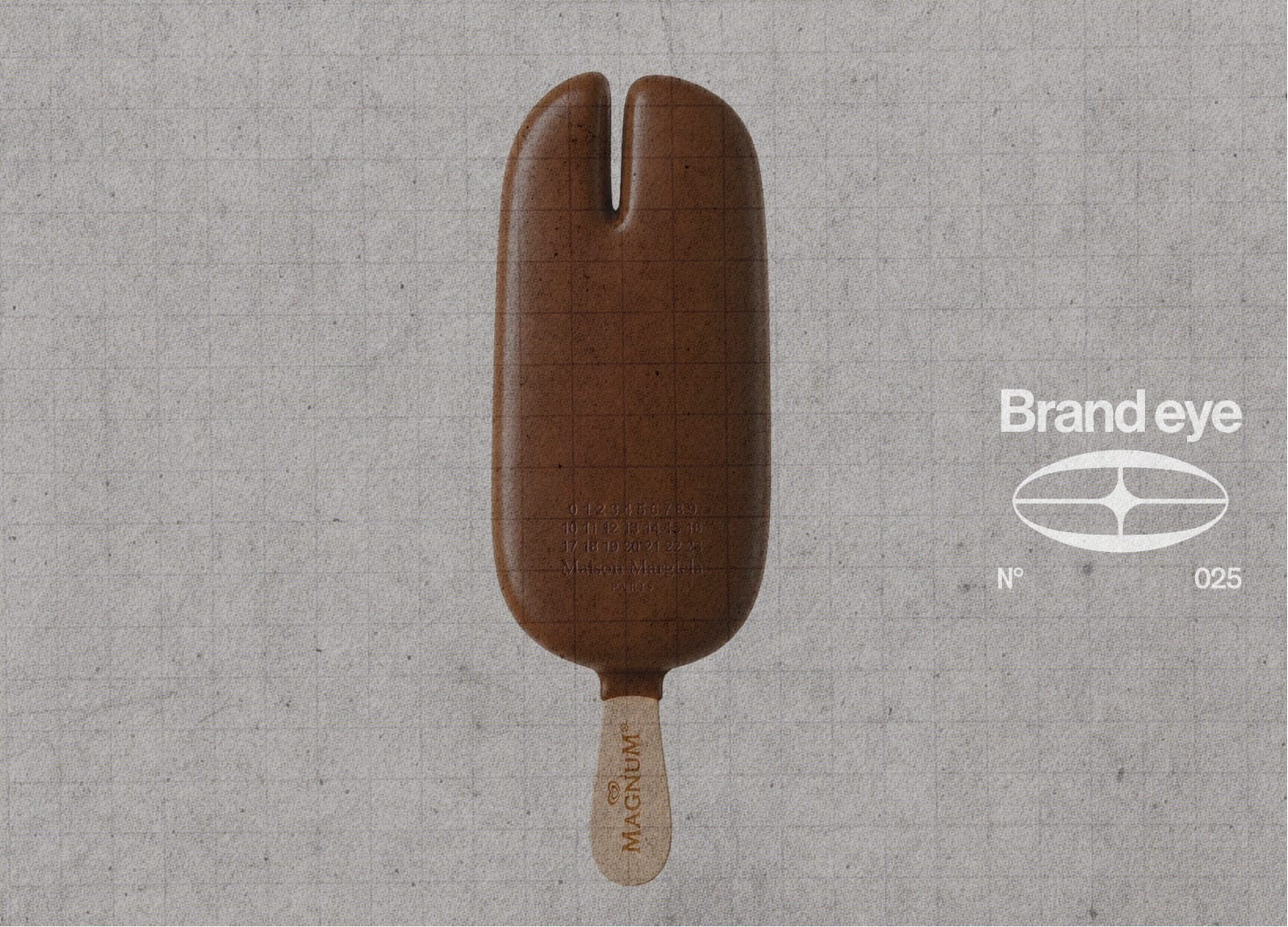
Let’s talk about a brand. A brand that’s got people sitting up and taking notice, from Paris Fashion Week to Cannes. That’s working with Alexander Wang, Bella Hadid and Charli XCX, Law Roach and Heidi Klum. Not to mention their beach club pop-up co-hosted with Rhode. What is this brand I hear you ask? Is it a buzzy new name in fashion? Yet another celebrity beauty line? Neither of the above. The brand we’re talking about is… Magnum?
That’s right. Magnum. Magnum the ice cream brand you can grab at your local 7-Eleven, put a couture dress made from cocoa bean husks on a Paris runway. But what exactly is the idea here? What’s behind this seemingly bizarre branding pivot and is it working?
What’s the idea behind the campaign?
Short answers to the above: They’re marketing ice cream like haute couture, an increasingly competitive premium ice cream market, and yes.
Long answer, well let’s start with why, shall we.
Why Magnum had to move
Quite simply, increased competition. In recent years, brands that position themselves as premium alternatives in the ice cream aisle have started to multiply. Where once Magnum may have only had to contend with Häagen-Dazs, there’s now an entirely new class of premium brands looking to gain a foothold. Jeni’s, Van Leeuwen, and increasingly slick supermarket own-brand that looks just about close enough to premium from two feet away. Compared to a legacy brand like Magnum, these newer competitors can often lay claim to a more contemporary and less obviously corporate brand, pushing elements like bespoke stores in prestigious neighbourhoods and, in the case of Van Leeuwen, their origins as a NYC food truck. Magnum’s own performance admits the damage, with shares down almost five points and consumers defecting to imitations. Worse, the classic had become the standard, and standard is the worst thing a premium product can be. For an existing player like Magnum it’s either restate their case for why they ought to be your go-to for that extra luxurious choice, or get outmanoeuvred by brands with more novelty.
Why fashion and not something else
So why copy your tactics from an industry that ostensibly has nothing to do with yours?
Magnum’s play might seem bizarre, but part of its power is that as strange as it feels on first look, it’s actually really obvious when you take a second to think about it. Sure, high fashion and ice cream seem incongruous, but only in the most literal-minded analysis of product. If you approach the branding from the perspective that what you’re actually selling is a premium option, an elevated choice in a market dominated by cheap standards, then the comparison is natural. In the simplest terms, Magnum is piggybacking off the decades of differentiation that built a moat around high fashion to say “we are to that pint of store-brand Waitrose vanilla what LV are to Zara”.
The playbook
What makes this more than a gimmick is how far they’ve gone to execute on it. Without the right system behind it the whole thing reads hollow, goofy and yes, cheap, which undermines the entire premise. Here’s the playbook, roughly in order of how hard each move is to copy.
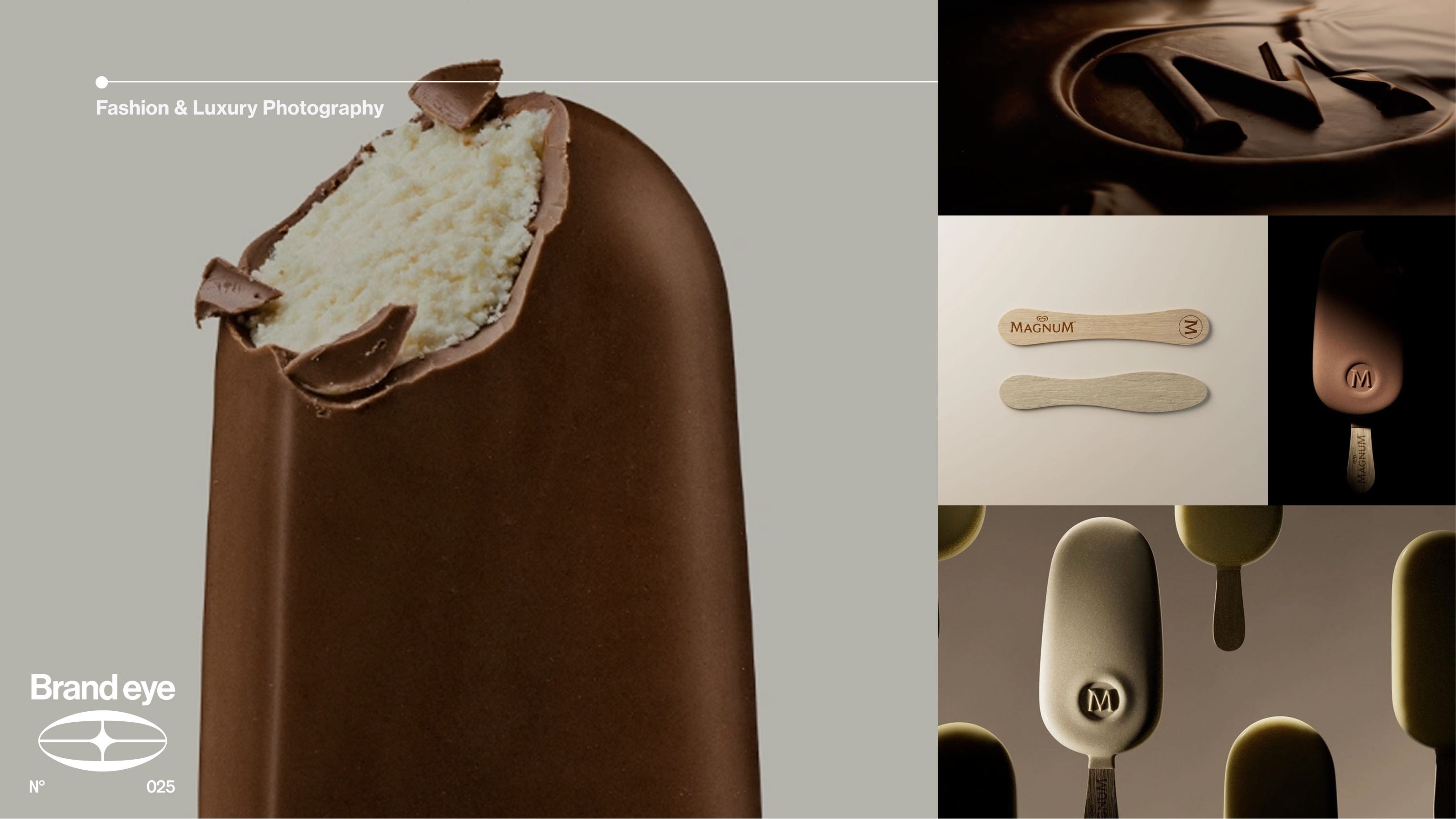
It starts with how the product is shot. Their product shots embrace the aesthetics of fashion and luxury photography rather than food photography, framing the ice cream as a sculptural object rather than a consumable. Floating product, fragrance-ad lighting, desire before appetite.
Then the monogram. Fashion houses mark everything they make, a brand in this context is more than a conspicuous logo it’s a label of quality guarantee. Magnum presses the M into the chocolate and engraves the name on the stick, on a product that gets eaten in four minutes.
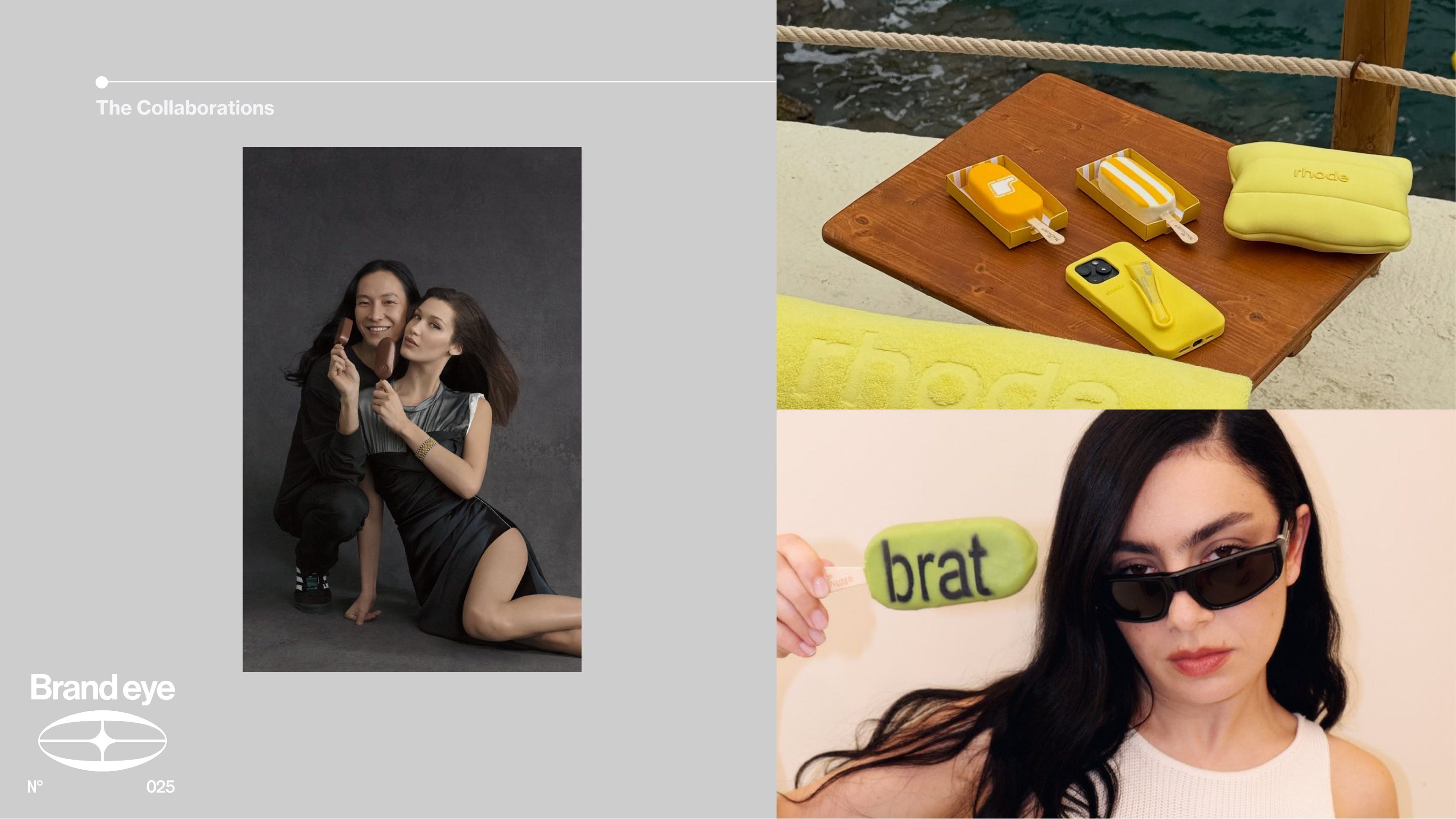
But every house also has a signature you know without the logo. Burberry has the check. Magnum took the crack of its chocolate covering and ran it across the advertising the way a house uses a print.
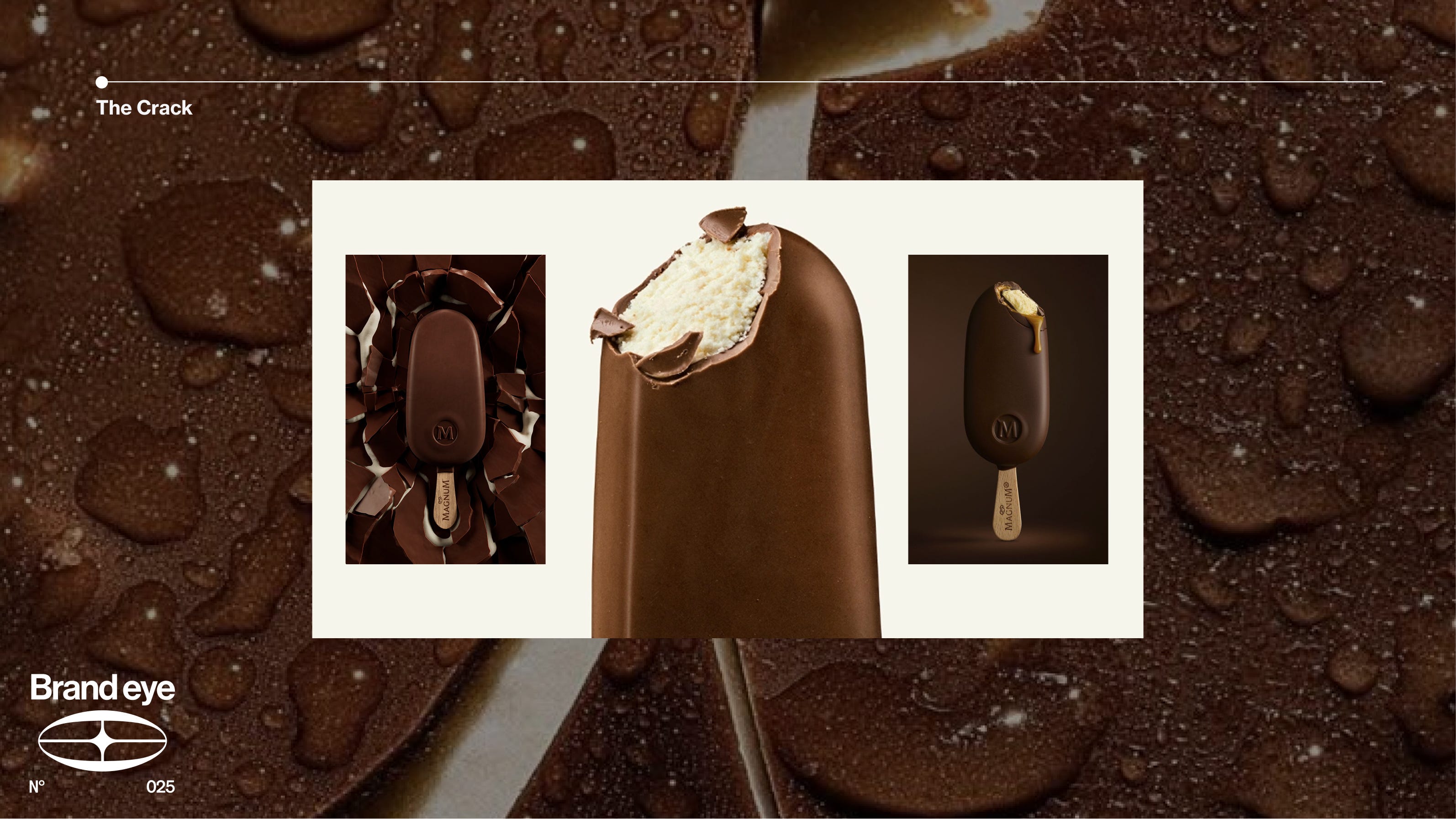
Then the collaborations, and this is where the casting logic shows. Household names (Klum), fashion stalwarts (Wang), industry-adjacent figures with enormous cultural capital right now (Charli). Sure, the Wang and Bella Hadid work started in 2016 but hold that thought.
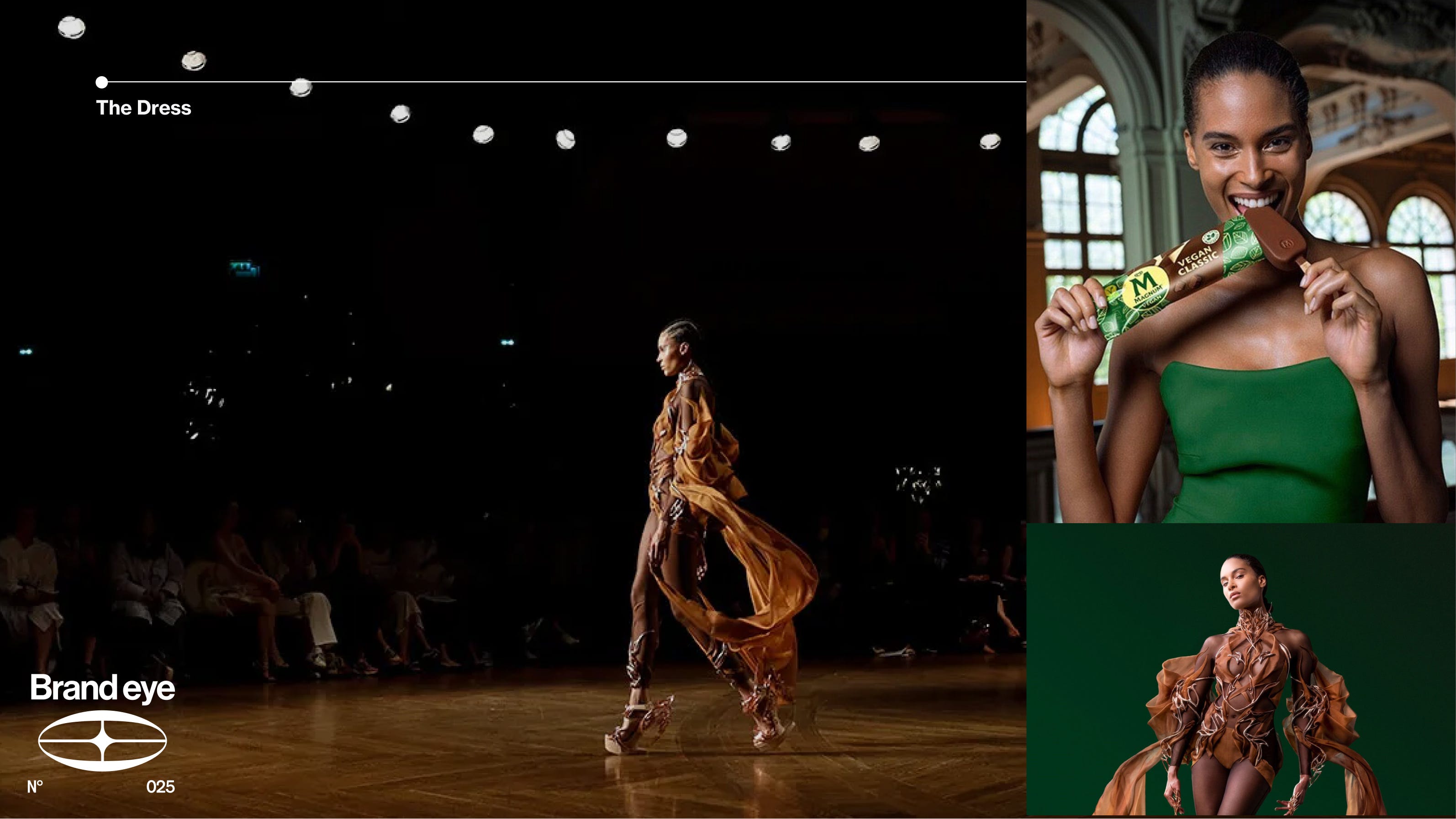
Then the dress. Paris, 2022. Iris van Herpen built a couture gown from cocoa bean husks, the waste from the ingredient in the bar, and Cindy Bruna walked it. Watch what Magnum didn’t do here. They didn’t stage their own show. They got a garment into somebody else’s, van Herpen’s fifteenth anniversary, and borrowed the whole room, already at attention for an admired creator with niche-specific clout. They avoided being a gimmick by coming in the side entrance instead of bursting in the front and disrupting, by being a participant in a culture, not a vulture picking strips off it.
And finally the show. May 2026, Cannes, Magnum’s first. Fifteen looks from eight designers on the Croisette, curated by Law Roach and closed by Heidi Klum. They gave Roach a title too, Taste Architect. Houses because don’t hire stylists, they appoint creative directors.
This took ten years
Which brings us back to Wang and Bella in 2016. The dress was 2022. The show in 2026. This isn’t just a momentary pivot for the brand, rather its a process, ten years of the same behaviour. If what we tried to get across above was that Magnum got away with this because of their attention to detail and their commitment, then the time-scale of this tactic is another piece of proof in support of that claim. Ten years is an ambitious timescale for any brand strategy, but ambition is what makes tactics like this work.
So is it working?
Well, yes, and the best evidence isn’t the catwalk.
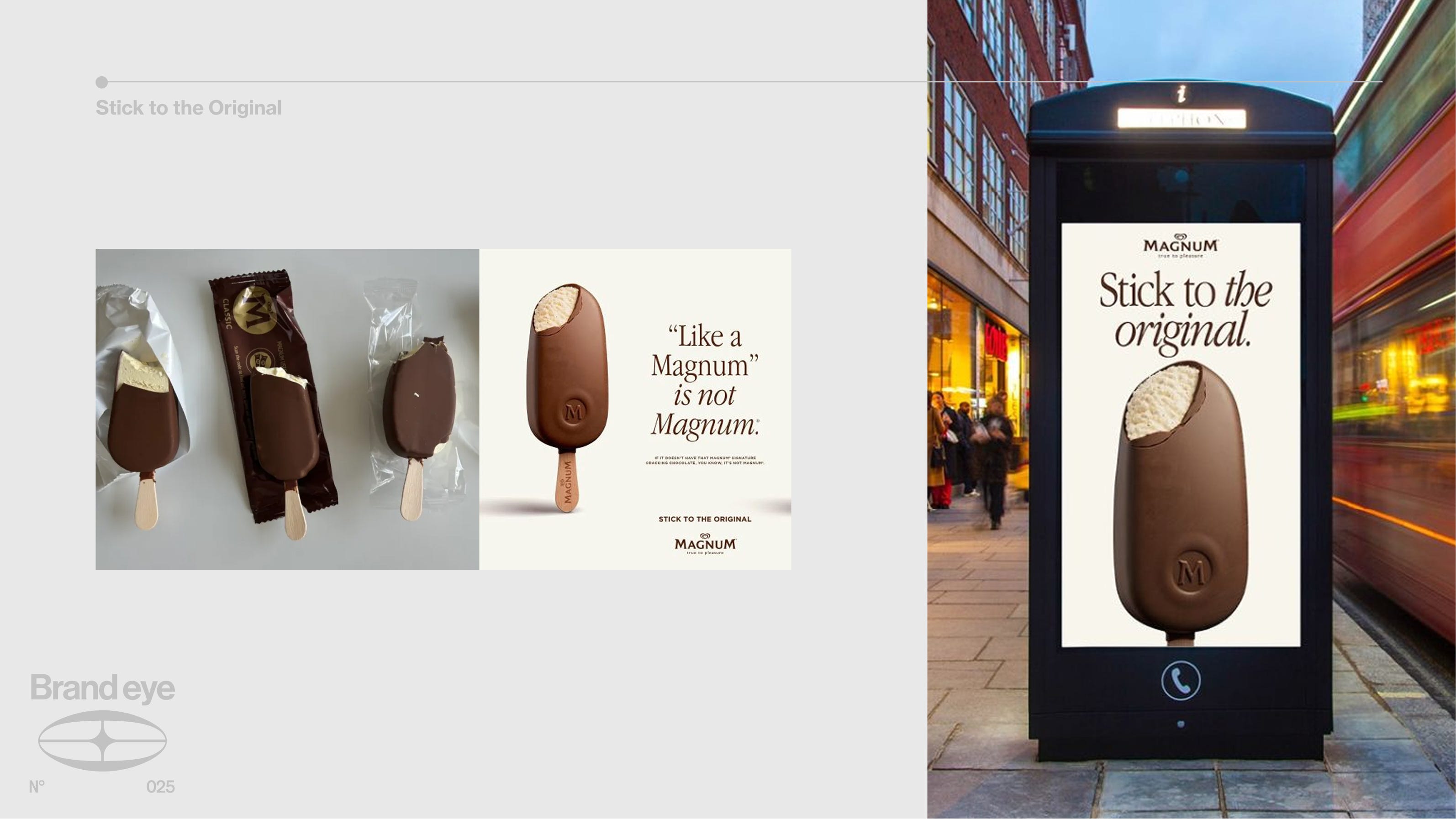
In 2024 Magnum ran an entire campaign against its own fakes. Stick to the Original. Like a Magnum is not Magnum. Brands don’t fight copycats in public unless the copy is worth making, and every house eventually inherits this problem. Indeed, getting counterfeited is a receipt of good work. The numbers point the same way, if more loosely: overall sales volume is up close to 5% year on year for 2026 per the FT, though that’s for the Magnum Ice Cream Company, which also produces Ben and Jerry’s, so treat it as direction rather than proof.
Takeaways
First up, Magnum’s branding shows how you can borrow lessons in positioning from other categories. Understanding your own industry matters, but understanding the deeper patterns of how brands differentiate themselves in other categories is what helps you stand out in yours.
Secondly, craft matters when you’re making references. Really knowing your stuff is what makes you come across as in on the joke and authoritative as a brand, not just chasing a trend.
Thirdly, collabs should be part of a wider approach. It’s not just about piggybacking off the exposure of personal brands, it’s about how they embed your product in an existing network of meaning. Choosing the right partners is what let this feel fluent and not cringe.
And lastly, the boring one. Ten years. Magnum didn’t hastily buy this position after sales dropped, they accumulated it one move at a time, most of them years apart.
I think the only perception Magnum strategy has successfully created is that it’s premium. Or it was…The product never really backed that claim enough in its quality or taste. And as more localised brands with interesting stories and emphasis on craft manage to gather a loyal audience i.e. Hackney Gelato, Lec, etc., they are not even noticeable at all. In fact, they have become the part of establishment and frankly they’re so boring. I obviously don’t know the numbers so my comment is purely my opinion rather than a reading of their performance.